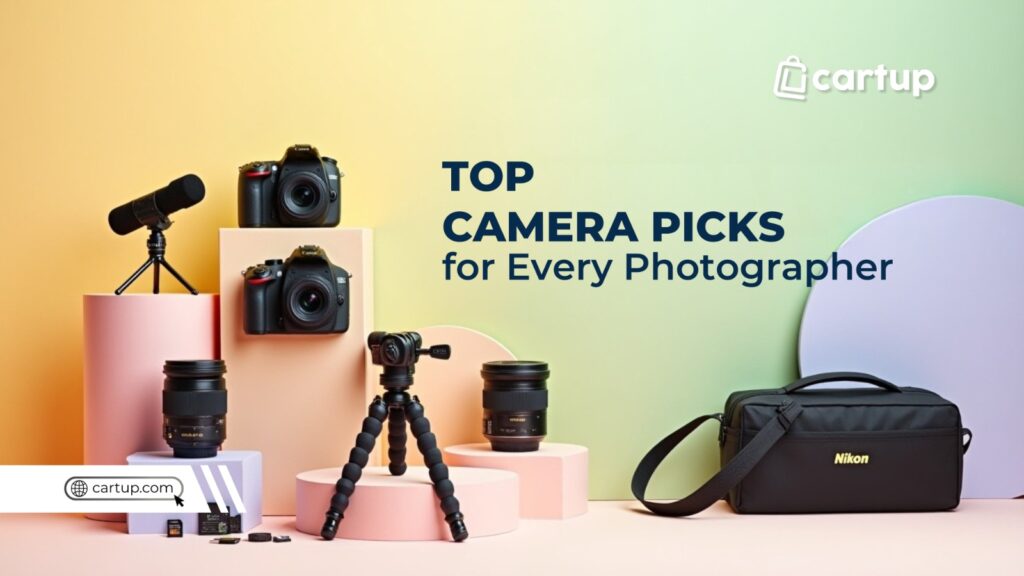
How do you find the right camera with so many types, features, and options? Whether you’re into photography, vlogging, or travel, understanding how to choose a camera with the right sensor size and autofocus system is essential for stunning shots.
Now get to explore the latest cameras for beginners to professionals to find the model that suits your style on cartup to discover lenses, tripods, and accessories that complement your setup naturally.
Key Takeaways
- Identify if you need a camera for photography, video, or hybrid use.
- Understand that different camera types serve specific purposes and users.
- Focus on key features like sensor size, ISO, autofocus, and IBIS.
- Consider portability, ergonomics, battery life, and lens compatibility.
- Plan for future needs with expandability, lens ecosystem, and versatility.
What Are Your Needs: Photography or Video?
Before comparing cameras, it’s essential to define your goals. Ask yourself:
- Will you primarily shoot photography or video?
- Are you focused on travel, vlogging, wildlife, or professional work?
- What is your budget range?
Different cameras are better suited for specific purposes:
- Photography-focused cameras prioritize resolution, dynamic range, and low-light performance.
- Video-focused cameras emphasize frame rate, codecs, rolling shutter performance, and autofocus systems.
What Are the Different Types of Cameras?
1. DSLR Cameras
DSLRs offer an optical viewfinder, long battery life, and a wide lens ecosystem. They are ideal for beginners and professionals who want reliable performance and excellent low-light capabilities, though they tend to be bulkier.
Best For: Beginners who want a solid all-around photography experience, professional photographers, and low-light shooting.
| Pros | Cons |
| – Optical viewfinder – Long battery life – Wide lens ecosystem. | – Bulkier – Heavier – Slower in live view video |
2. Mirrorless Cameras
Mirrorless cameras are compact and lightweight, featuring advanced autofocus systems like eye-AF and in-body image stabilization. They are perfect for travel, vlogging, and hybrid photography/video.
Best For: Travel, vlogging, and hybrid photography/video.
| Pros | Cons |
| – Compact – Lightweight – Advanced autofocus – Faster burst shooting, | – Slightly shorter battery life – Fewer native lenses in some ecosystems. |
3. Compact Cameras
Compact cameras are small, easy to carry, and convenient for casual photography. While they have fewer manual controls, they are great for everyday use and on-the-go shooting.
Best For: Casual photography and on-the-go shooting.
| Pros | Cons |
| – Small and easy to carry – Convenient for travel | – Limited manual controls – Smaller sensor |
4. Action Cameras
Action cameras are rugged, waterproof, and capable of high-frame-rate video. They are designed for sports, adventure, and vlog-style filming but have smaller sensors than DSLRs or mirrorless cameras.
Best For: Sports, adventure, and vlogging.
| Pros | Cons |
| – Waterproof – Rugged – 4K/6K/8K video capable – High frame rates. | – Limited manual controls – Small sensor |
5. Instant and Film Cameras
Instant and film cameras offer a creative and nostalgic photography experience. They are best suited for hobbyists or those who enjoy artistic, tangible prints rather than digital flexibility.
Best For: Hobbyists and artistic photography.
| Pros | Cons |
| – Unique, tangible photographic experience – Experimentation with composition and exposure | – Limited settings – Costly film |
6. Camcorder / Video Camera
Designed mainly for video recording, camcorders offer high frame rates, 4K/6K/8K support, and long recording times, making them ideal for filmmakers and vloggers.
Best For: Filmmakers, vloggers, and anyone focused on video content
| Pros | Cons |
| – Excellent for long-duration video recording – High frame rates and smooth video quality – Built-in audio and connectivity options | – Large and less portable – Limited photography capabilities |
7. Digital Camera
Digital cameras are versatile and suitable for both photography and video, with features like adjustable ISO, autofocus systems, and various lens options.
Best For: Beginners to advanced photographers wanting an all-rounder camera
| Pros | Cons |
| – Versatile for both photography and video – Adjustable settings like ISO, shutter speed, and aperture – Wide lens compatibility | – Can be bulky depending on the model – Some advanced features may have a learning curve |
8. Instant Camera
Instant cameras provide fun, tangible prints instantly, perfect for hobbyists or creative photography, though they lack digital flexibility.
Best For: Hobbyists, parties, and artistic photography enthusiasts
| Pros | Cons |
| – Produces instant prints for creative fun – Easy to use with minimal settings | – Limited digital control – Ongoing cost of film and prints |
9. Mini Camera
Compact and portable, mini cameras are great for travel, casual photography, or on-the-go shooting, offering convenience over advanced features.
Best For: Travelers, casual photography, and on-the-go shooting
| Pros | Cons |
| – Ultra portable and lightweight – Easy to carry while traveling | – Smaller sensors limit image quality – Fewer manual controls |
10. 360 / Action Camera
Rugged and often waterproof, 360 and action cameras capture immersive footage and high-frame-rate video, perfect for adventure and sports.
Best For: Adventure sports, travel vloggers, and immersive content creators
| Pros | Cons |
| – Waterproof and rugged for extreme conditions – Captures immersive 360° footage and high frame rates | – Small sensor limits low-light performance – Limited control for creative photography |
11. Security & CCTV Camera
Primarily used for surveillance, these cameras focus on continuous recording, low-light performance, and durability rather than creative photography.
Best For: Home security, businesses, and surveillance purposes
| Pros | Cons |
| – Reliable for continuous monitoring – Durable and optimized for low-light conditions | – Not suitable for creative photography or high-quality video – Fixed features, limited flexibility |
What Camera Features Should You Consider?
When choosing a camera, some features are more important than others, depending on your needs. Here are the top 7 features to focus on:
1. Sensor Size
Full-frame, APS-C, or Micro Four Thirds sensors affect low-light performance, depth of field, and crop factor. Larger sensors generally capture more detail.
2. Resolution & Dynamic Range
Higher megapixels capture finer details, while better dynamic range helps retain highlights and shadows in challenging lighting.
3. ISO Performance
Determines how well your camera performs in low light without producing excessive noise or grain.
4. Autofocus (AF) Systems
Look for cameras with eye-AF, subject tracking, and multiple autofocus points to keep your subjects sharp in photos and videos.
5. In-Body Image Stabilization (IBIS)
Reduces motion blur in photos and minimizes camera shake during handheld video recording.
6. Video Capabilities
Check frame rates (fps), 4K/6K/8K support, bit rate, codec, and rolling shutter performance for smooth, high-quality video.
7. Lens Ecosystem
Ensure your camera’s lens mount is compatible with a variety of prime and zoom lenses, and that native lenses are readily available for future upgrades.
Which Cameras Are Best for Your Specific Needs?
1. Best Cameras for Beginners
2. Cameras for Vlogging
3. Best Travel Cameras
4. Best Cameras Under 10,000 TK
What Are the Camera Buying Tips for Beginners?
1. Decide Your Primary Use
Choose whether your focus is photography, video, or a hybrid setup to guide your camera selection.
2. Set a Budget
Factor in the cost of camera body, lenses, and accessories when planning your purchase.
3. Compare Mirrorless vs DSLR
Consider portability, autofocus performance, and lens options to pick the right system.
4. Check Key Features
Look at sensor size, image stabilization, ISO performance, and video frame rate for overall performance.
5. Try Before You Buy
Handle cameras to test ergonomics, weight, and ease of use before making a decision.
6. Future-Proof Your Purchase
Think about the lens ecosystem, resale value, and expandability for long-term use.
How To Choose a Lens?
1. Focal Length
Pick wide-angle for landscapes, telephoto for wildlife, or standard lenses for portraits.
2. Aperture (f-number)
Lower f-numbers give a shallow depth of field and better low-light performance.
3. Prime vs Zoom Lenses
Prime lenses are sharper, while zoom lenses offer versatility for different scenes.
4. Compatibility
Ensure the lens mount matches your camera body and supports the available lens ecosystem.
Choosing the perfect camera for your needs requires balancing purpose, budget, and key features. From mirrorless vs DSLR to lenses, sensor size, and video capabilities, this guide covers everything a beginner or enthusiast needs.
FAQ
1. How do I choose a camera for both photography and video?
Look for hybrid cameras with fast AF, IBIS, good ISO performance, and high frame-rate video capabilities.
2. Which is better for beginners, mirrorless or DSLR?
For beginners, a mirrorless camera is good; it’s lighter and offers advanced video features, while DSLRs provide longer battery life and a wide lens ecosystem.
3. What is the best camera for beginners under 10,000 TK?
Cameras like the NativeCam 4k Action, Canon EF-S 18-5 DSLR , HP F480W 3MP FHD Camcorder offer easy handling and good image quality at a budget-friendly price.
4. What features to prioritize for travel photography?
Lightweight body, IBIS, good low-light performance, and versatile lenses.
5. How do I choose the right camera lens for portrait photography?
Select a lens with a focal length of 50–85mm, a wide aperture (f/1.4–f/2.8), and a prime lens option for sharper portraits.
6. How do I choose a camera that’s good for both travel and vlogging?
Pick a lightweight, compact camera with strong autofocus, in-body image stabilization (IBIS), good low-light performance, and a versatile lens ecosystem to handle both travel photography and video content.